
Prompt Engineering & Context Engineering: A Beginner’s Guide
Prompt engineering is the single highest-ROI skill you can develop for working with AI. It is the difference between getting generic, forgettable answers and getting insights that actually move your work forward. This guide covers what prompt engineering really means, how it differs from the more advanced practice of context engineering, and how to start getting better results from any AI tool today, whether you are drafting emails, analyzing data, or researching competitors.
Why Prompt Engineering Matters More Than You Think
Think of an AI as an incredibly knowledgeable expert who answers exactly what you ask — nothing more, nothing less. If you ask vaguely, you get a vague answer. If you ask precisely and with relevant context, you get a powerful, targeted response.
Most people use maybe ten to twenty percent of an AI’s potential because they treat it like a search engine. They type a few words and expect magic. With good prompting, you unlock the other eighty percent.
A bad prompt: “Tell me about marketing.”
A good prompt: “You are a marketing expert specializing in home security systems. My target audience is homeowners over fifty in Florida. Give me five short ad hooks for Facebook that address fear of home invasion, each under fifteen words and written with an urgent but trustworthy tone.”
Same AI. Completely different output quality. The difference is not the model. It is the instruction. That distinction is the entire point of prompt engineering: you are the one who determines the quality of the output.
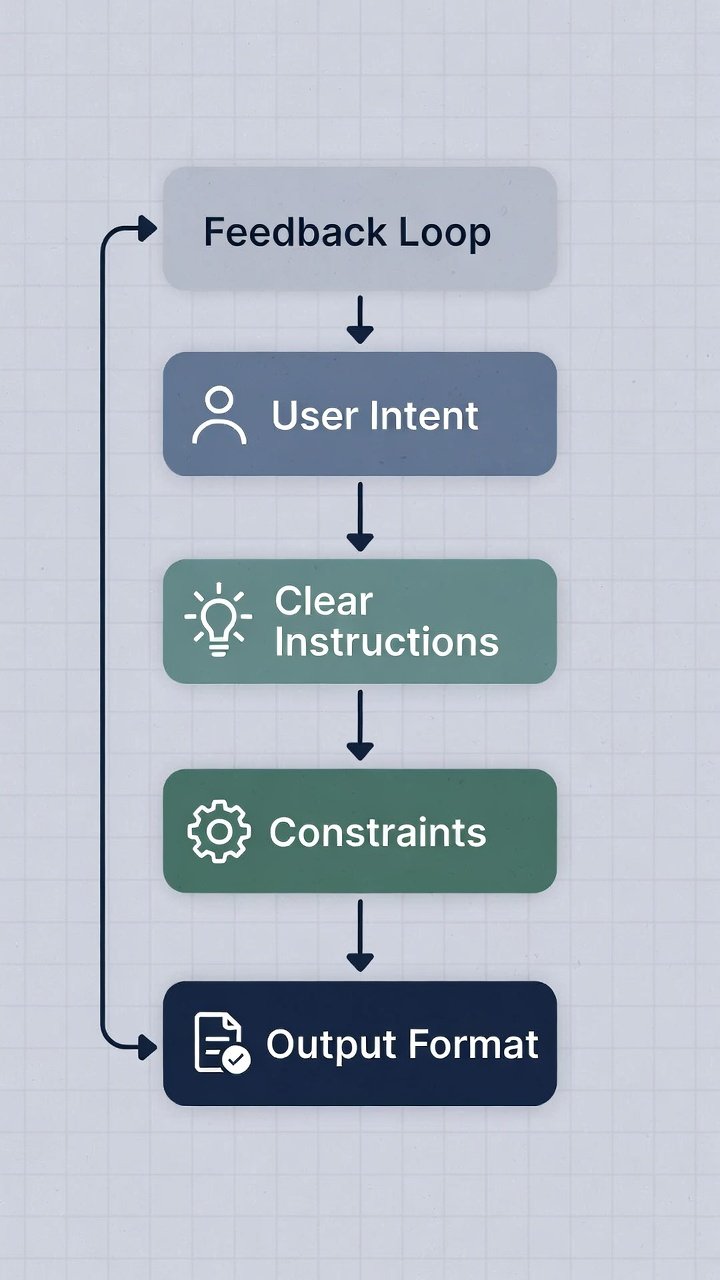
The Five Building Blocks of a Strong Prompt
Every effective prompt combines some mix of these elements, and understanding them is the fastest path to consistently better AI results.
Role — Tell the AI what expert identity to adopt. “Act as a senior financial analyst reviewing quarterly results.” “You are a customer success manager with ten years of experience in SaaS.” The role sets the frame for everything that follows.
Context — Give background so the AI understands your specific situation. Include relevant details about your industry, audience, goals, and constraints. This is where most people fall short. A prompt with no context produces generic output. A prompt with rich context produces output tailored to your exact needs.
Task — Be specific about what you want done. “Summarize this quarterly report in three bullet points” is clearer than “Tell me about this report.” “Draft a follow-up email to a prospect who went dark after a demo” is clearer than “Help me with sales.”
Format — Specify how you want the answer delivered. “Give me a table comparing these options.” “Write this as a bulleted list for a presentation.” “Explain it like I am new to the field.” Format instructions eliminate the guesswork that wastes iterations.
Constraints — Set boundaries that focus the output. “Keep it under two hundred words.” “Avoid industry jargon.” “Write in plain language a non-technical stakeholder would understand.” Constraints prevent the AI from going broad when you need tight, focused answers.
When you consistently include these elements, your AI outputs move from generic to genuinely useful in a single attempt, rather than requiring multiple rounds of refinement.
Prompt Engineering Versus Context Engineering
These terms are often used interchangeably, but they describe different levels of the same skill, and understanding the difference is important for anyone investing in AI training.
Prompt engineering is crafting a single well-structured question or instruction to get the best one-time response. It is about how you phrase the ask in that moment. You tell the AI who to be, what to do, and how to deliver it, all in one shot.
Context engineering is a more advanced practice. It is about building and managing the entire environment around a conversation. This includes feeding the AI background documents, conversation history, persistent memory, persona definitions, and layered instructions that shape every response throughout a long interaction.
Think of the difference like this: prompt engineering is asking a contractor a single good question. Context engineering is handing them a full project brief, a site survey, a budget, and a timeline before they ever pick up a tool. The second approach produces consistently better work because the AI operates from a richer understanding of your world.
Context engineering matters most for ongoing tasks. A customer support agent that maintains consistent brand voice across hundreds of interactions. A research assistant that builds on previous findings over weeks. A document analyst that applies the same framework to every new submission. These are use cases where the upfront investment in context pays back every time.
How Different AI Platforms Respond to Prompting
One of the most common frustrations is discovering that a prompt that works beautifully on one AI falls flat on another. Different models have different training and architecture, which means they respond differently to the same instruction.
ChatGPT handles direct, conversational prompting well. It follows clear step-by-step instructions naturally and handles roleplay and persona prompts without much structure. It is somewhat forgiving of loose phrasing.
Claude responds well to nuanced, layered instructions and complex context. Structured prompts using clear sections for role, task, and constraints produce reliable results. Detailed system-level instructions and early context establishment are especially effective for longer conversations.
Gemini integrates with Google’s ecosystem and responds well to prompts that leverage real-time data, search context, and structured factual queries. It shines on research and data synthesis tasks when prompts guide it toward those strengths.
Copilot is optimized for productivity tasks within Microsoft products. Prompts work best when tied to specific documents, spreadsheets, or email contexts already open in the application.
Open-source models like Llama, Mistral, and Qwen often require more explicit, structured prompting because they have less embedded training on conversational nuance. You typically need to be more literal and less conversational to get consistent results from these models.
The practical takeaway: learn the prompting style that works for your primary AI tool, but understand that the skills transfer across any model you encounter.
How to Start Improving Your Prompts Today
You do not need a course or a certification to get better at prompt engineering. Start with one habit: before you send any prompt, ask yourself whether you have included who the AI should be, what you need, and how you want it delivered.
If you are using AI for ongoing work — drafting emails, analyzing documents, researching competitors — invest in context engineering by building a short system prompt that describes your business, your audience, and your quality standards. Paste it at the start of every new conversation. You will see the quality difference immediately.
Prompt engineering and context engineering are skills that compound. Every good prompt teaches you something about how to frame the next one better. And because they apply across every AI tool you will ever use, from ChatGPT to Claude to Gemini to open-source models, they are skills that never become obsolete regardless of which platform dominates the market.
For teams that want to build skills that multiply the value of every AI tool they already own, structured executive AI training programs provide a clear pathway from basic prompting techniques to advanced context engineering workflows.