
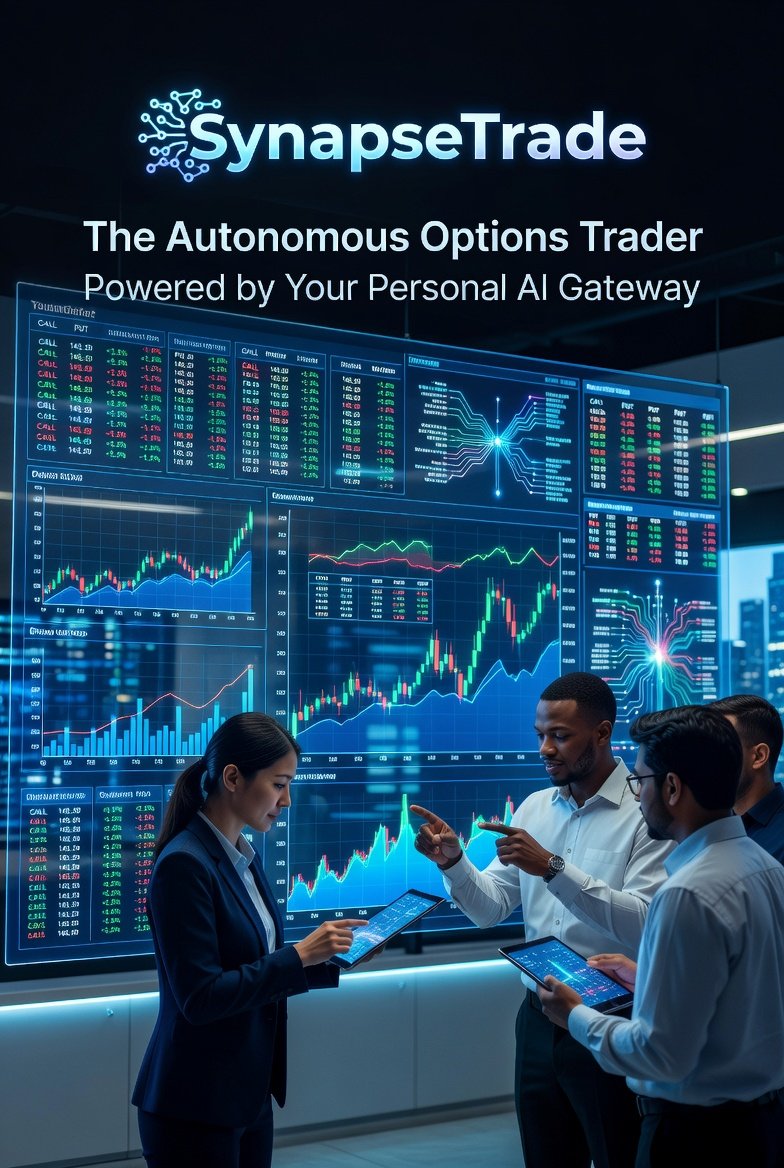
AI Options Trading: How to Build Your Autonomous Trader
The promise of AI options trading is no longer a Wall Street fantasy reserved for hedge funds with billion-dollar infrastructure. With today’s accessible AI agents and brokerage APIs, anyone can build a personal autonomous trader that runs from a messaging app. This guide breaks down how AI-powered trading systems actually work, what they can and cannot do, and how to evaluate whether an autonomous options trader fits your financial strategy.
What Makes an Autonomous Options Trader Different
Traditional trading requires constant screen time, emotional discipline, and split-second decisions. Even seasoned traders blow up accounts because fear or greed overrides their strategy. An AI options trader removes the emotional variable entirely by executing a predefined strategy algorithmically, without hesitation or second-guessing.
An autonomous options trader built on AI operates through three interconnected layers that work together continuously.
Market Intelligence Engine — A real-time analysis system that ingests financial data feeds, news sentiment, earnings reports, options chain metrics, and technical indicators. Rather than relying on a single source, it cross-references multiple streams to identify opportunities most humans would miss. This layer runs constantly, scanning for setups that match your predefined criteria and alerting you only when something actionable surfaces.
Decision Logic — The trading rules and risk parameters you define. This is where your personal strategy lives: which strikes to target, what implied volatility percentile to act on, how much capital to risk per trade, and when to exit. The decision logic is the part of the system you configure carefully, because it encodes your market thesis and risk appetite. Change your strategy, and you update the logic, not the whole system.
Execution Layer — The bridge between your AI agent and your brokerage account. The system can place orders, set stop-losses, roll positions, and adjust exposure without you touching a keyboard. This layer handles the operational mechanics, including order routing, error handling, and post-trade reconciliation.
The three layers form a continuous feedback loop. The intelligence engine feeds the decision logic, which triggers the execution layer, which reports back to the intelligence engine with trade outcomes. Over time, the system builds a record of what worked and what did not, refining its pattern recognition and adapting to changing market conditions.
Why Messaging Apps Make Sense for Trading Bots
The most practical interface for an autonomous options trader is the messaging app already on your phone. Platforms like Telegram, WhatsApp, and Slack support bot integrations that let an AI agent message you directly with trade alerts, daily summaries, and risk warnings.
This messaging-native approach has real advantages. Your bot can send a morning briefing with the day’s key setups based on overnight market movements. It can ping you when implied volatility hits your target threshold on a specific ticker. It can summarize your portfolio exposure, delta, and gamma before market open so you start the day informed.
You respond with simple commands like “approve trade,” “tighten stop to five percent,” or “pause all trading.” No complex platform. No logins during market hours. The bot handles the operational heavy lifting while you stay in control of strategic decisions.
The same concept of a personal AI agent handling complex workflows from a simple chat interface has applications far beyond trading. The same architecture that powers an autonomous trader can also manage your calendar, research competitors, monitor industry news, or automate customer follow-ups.
Core Components You Need to Build
Building your own AI options trading assistant requires assembling a few key components. None are exotic, and most are available as open-source or low-cost API services.
The AI Agent Framework — This is the brain. Open-source frameworks like Clawdbot, LangChain, or custom GPT assistants provide the conversational interface and the reasoning layer that decides when and how to act. The agent maintains persistent memory of your trading history, risk tolerance, and preferred strategies, learning your style over time.
Market Data Feeds — Real-time options data is essential. Services like Polygon, Tradier, or Interactive Brokers provide streaming price data, Greeks, implied volatility bands, and options chain snapshots. The quality of your trading depends directly on the speed and accuracy of this data, so choose a provider with low latency and broad market coverage.
Brokerage API Integration — Your agent needs a brokerage account with API access. Interactive Brokers, Alpaca, and Tradier offer mature APIs that let automated systems place orders, check balances, and manage positions. This is the most sensitive integration point. Every order goes through your brokerage’s risk checks, and you control the connection.
Risk Management Guardrails — The most critical component. Your agent should have hard limits it cannot override: maximum position size, maximum daily loss, maximum delta exposure, and a kill-switch that halts all trading if volatility spikes beyond a threshold. These guardrails should live in code, not in the agent’s instructions, so they cannot be talked around by a clever prompt.
The Risk Reality No One Emphasizes Enough
Autonomous options trading sounds like a cheat code for passive income, but the risks are substantial and real. Options are leveraged instruments, and leverage amplifies losses as efficiently as gains. An AI trader that works beautifully in backtesting can fail catastrophically in a regime shift — a surprise Fed decision, a geopolitical flash event, a sudden volatility collapse.
The honest pitch for an AI options trader is not that it eliminates risk. It eliminates the emotional errors that destroy trading accounts: revenge trading after a loss, FOMO on a breakout, refusing to take a loss because it feels bad. If your personal weakness is holding losing positions too long or overtrading, an autonomous system can fix that. It cannot fix a bad strategy or protect you from black swans.
The right approach is to start with a paper-trading account. Run your agent against simulated capital for at least three months across different market conditions — low volatility, high volatility, trending, and ranging markets. Only then consider putting real money behind it, and even then, start with capital you can afford to lose entirely.
If the concept of building a personal AI agent for complex automation interests you, our guide to setting up your own personal AI gateway covers the foundational architecture that makes autonomous systems like this possible. That architecture — an AI agent with persistent memory, API connections to external services, and a messaging interface — is the same blueprint used across dozens of real-world applications beyond financial trading.
How This Fits Into Your Broader AI Strategy
Building an AI options trader is an advanced application of principles that power practical workplace AI tools: data ingestion, pattern recognition, rules-based decision making, and automation of repetitive tasks. The same skills you develop — prompt engineering, workflow design, API integration, risk parameterization — transfer directly to building AI systems for business operations, customer support, or financial management.
If you are exploring how autonomous AI agents can transform your work, start with lower-stakes applications before graduating to live financial markets. The underlying architecture is the same, and mastering it on simpler use cases builds the confidence and skill to tackle more complex applications later.
For professional guidance on integrating AI agents into your business operations, Invetech provides training and consulting tailored to real-world workflows, not theoretical demos.