
How to Prepare for Workplace AI Without Losing Your Footing
As artificial intelligence reshapes how companies operate, knowing how to prepare for workplace AI has become the defining career skill of this decade. The headlines about job displacement create a natural anxiety, but the data tells a more nuanced story. The current wave of AI adoption isn’t eliminating jobs wholesale — it’s transforming them. Workers who invest in preparation today aren’t just protecting their careers; they’re positioning themselves for opportunities that didn’t exist three years ago.
What Actually Changes When AI Enters Your Workplace
The first step in preparing for workplace AI is understanding what the technology actually changes about your daily work. AI systems today excel at pattern recognition, data processing, and generating first-draft content across text, images, and code. They struggle with tasks requiring genuine judgment, emotional nuance, ethical reasoning, and contextual awareness that spans beyond their training data.
This means the work that survives — and thrives — in an AI-augmented workplace is the work that demands human discernment. A customer service agent who used to spend 60 percent of their time answering routine questions can now hand that load to an AI assistant and focus on the complex, high-stakes cases where empathy and creative problem-solving make the difference. A data analyst who previously spent hours pulling reports can redirect their energy toward strategic interpretation and client advisory.
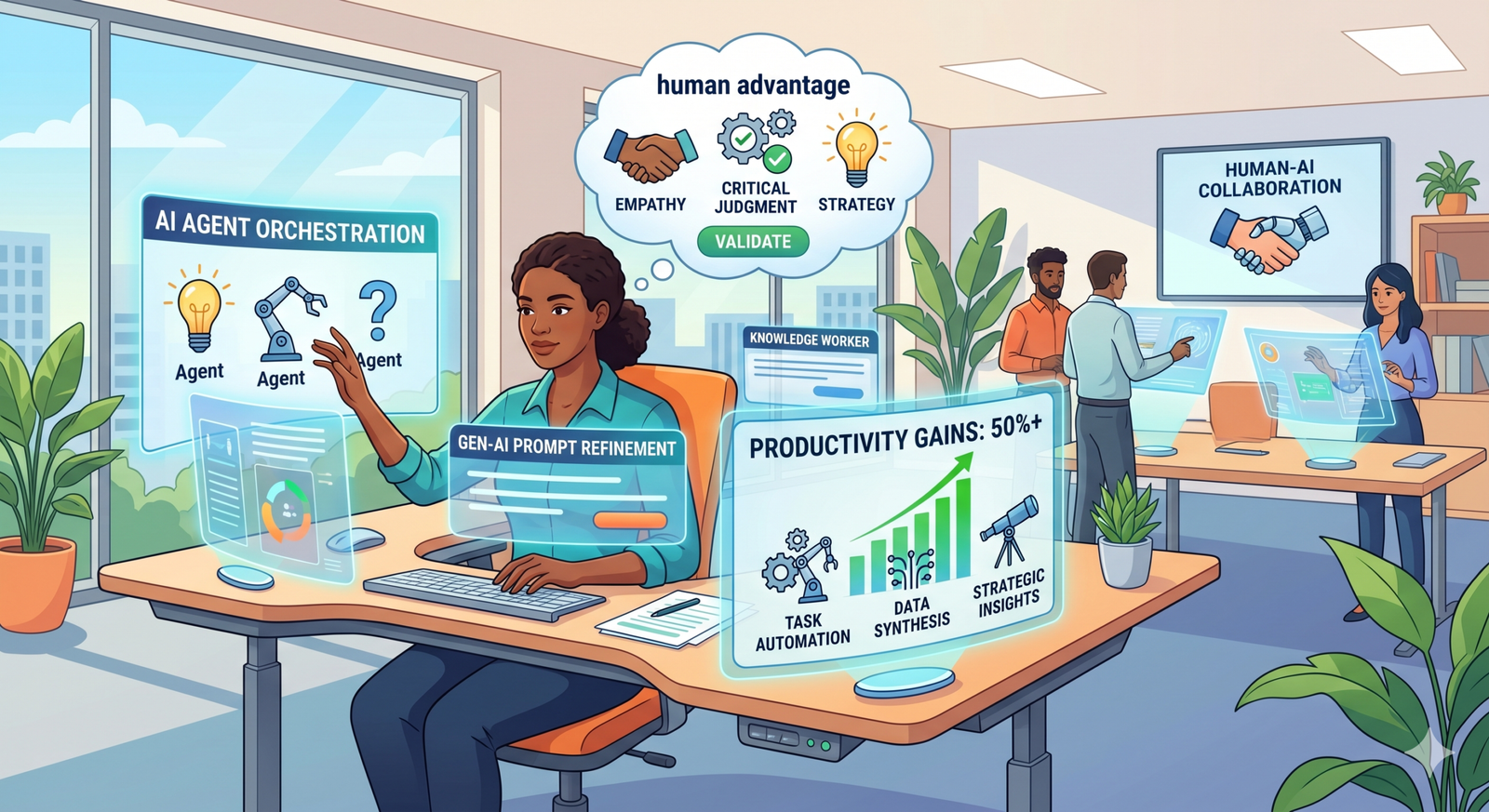
The skill sets that gain value in this environment are the ones AI cannot replicate. Critical thinking, complex problem-solving, socio-emotional intelligence, ethical judgment, and creative direction all become more valuable precisely because the technology makes everything else cheaper and faster. Preparing for workplace AI means doubling down on these capabilities while building the technical fluency to direct AI tools effectively.
Building the Technical Fluency That Commands a Premium
You do not need to become a data scientist to thrive alongside AI. But you do need enough technical fluency to instruct AI systems effectively and evaluate their outputs critically. The most immediately valuable technical skill in the current market is prompt engineering — the practice of crafting precise instructions that get AI tools to produce useful, accurate results. This skill commands a significant wage premium because it directly determines whether an AI investment delivers a return or generates mediocre outputs that require heavy human correction.
Beyond prompting, the next layer of preparation involves understanding orchestration — how to chain multiple AI tools together to accomplish complex workflows. As agentic AI systems that can plan and act autonomously become more common, the human role shifts from executing tasks to designing and supervising workflows. Think of it as moving from being a musician to being a conductor. You don’t play every instrument, but you understand how they work together and when each one should take the lead.
Building this fluency doesn’t require expensive programs. Micro-learning through hands-on experimentation, peer collaboration through internal “AI office hours,” and structured resources from credible platforms all provide practical paths forward. The key is consistent, applied practice rather than passive consumption of tutorials. If you want a structured starting point, our guide to mastering artificial intelligence to secure your job and boost your career walks through the specific capabilities that employers are prioritizing in today’s hiring landscape.
Adopting a Lifelong Learning Mindset That Actually Works
The shelf life of technical skills is shrinking faster than any point in modern history. Skills in AI-exposed roles are churning 66 percent faster than in other fields. A certification you earn today may describe tools that have been superseded within eighteen months. This doesn’t mean learning is futile — it means the approach to learning must change.
Formal degrees and one-time training programs are becoming less relevant as credentials. Employers increasingly care about what you can do today, not what you studied five years ago. The most effective preparation strategy combines continuous micro-learning with deliberate practice. Spend thirty minutes each week experimenting with a new AI application relevant to your field. Keep a journal of what works and what doesn’t. Share findings with colleagues. Teach someone else what you learned — teaching is the fastest path to mastery.
This approach also builds a critical habit: comfort with iteration. Preparing for workplace AI means accepting that you will never be “done” learning. The goal is not to achieve a fixed level of competence but to build the muscle of adaptation itself. Workers who embrace this mindset consistently outperform those who chase specific tool certifications.
Practical Steps You Can Take This Week
Preparing for workplace AI doesn’t require a dramatic career pivot. The most effective preparation fits into existing workflows. This week, identify one task you do regularly that follows a predictable pattern — drafting a status report, summarizing a meeting, formatting data for a presentation. Experiment with using an AI tool to produce a first draft or initial pass. Compare the output to what you would have written. Refine your instructions to the tool based on what it got wrong.
Repeat this cycle with a different task next week. Over a month, you will develop a reliable sense for which parts of your work AI handles well and where your judgment remains essential. This experiential knowledge is far more valuable than abstract AI literacy because it’s grounded in your actual role and context.
Share what you learn with a colleague. Teaching someone else to get better results from an AI tool reinforces your own understanding and builds the kind of collaborative learning culture that makes organizations more resilient to change.
Reframing Your Role Around Higher-Value Work
The most practical preparation strategy available to any worker right now is to reframe their current role around higher-value contributions. Look at your job description and identify the tasks that consume the most time but require the least judgment. Those are the tasks AI can handle. Your opportunity is to evolve into the role that supervises, refines, and builds on AI outputs.
In practice, this looks different across every function. A recruiter who spends hours screening resumes can hand that work to an AI matching tool and redirect their energy toward candidate experience, culture assessment, and strategic workforce planning. A financial analyst who runs routine variance reports can automate that process and focus on scenario modeling and executive decision support. A marketing coordinator who drafts social posts can use AI for the first pass and spend their time on campaign strategy and performance analysis.
The through line is consistent: prepare for workplace AI by identifying where your human skills add unique value and systematically investing in those areas while delegating the predictable work to machines.
Moving Forward With Confidence
The organizations that will thrive in the next five years are not the ones with the most advanced AI infrastructure. They are the ones whose people know how to collaborate with AI tools effectively. Individual workers who invest in preparation today will find themselves in high demand as companies scramble to build AI-literate teams.
Start with the skills that play to your strengths as a human — judgment, creativity, empathy, ethical reasoning. Layer in enough technical fluency to direct AI tools with precision. Commit to continuous learning as a habit rather than an event. And reframe your role around the work that only you can do. The future of work is not about competing with AI. It’s about partnering with it to do what neither could do alone.
At Invetech, we work with professionals and teams who want to build practical AI skills that apply directly to their daily work. The preparation you invest in now determines the opportunities you’ll have tomorrow.