
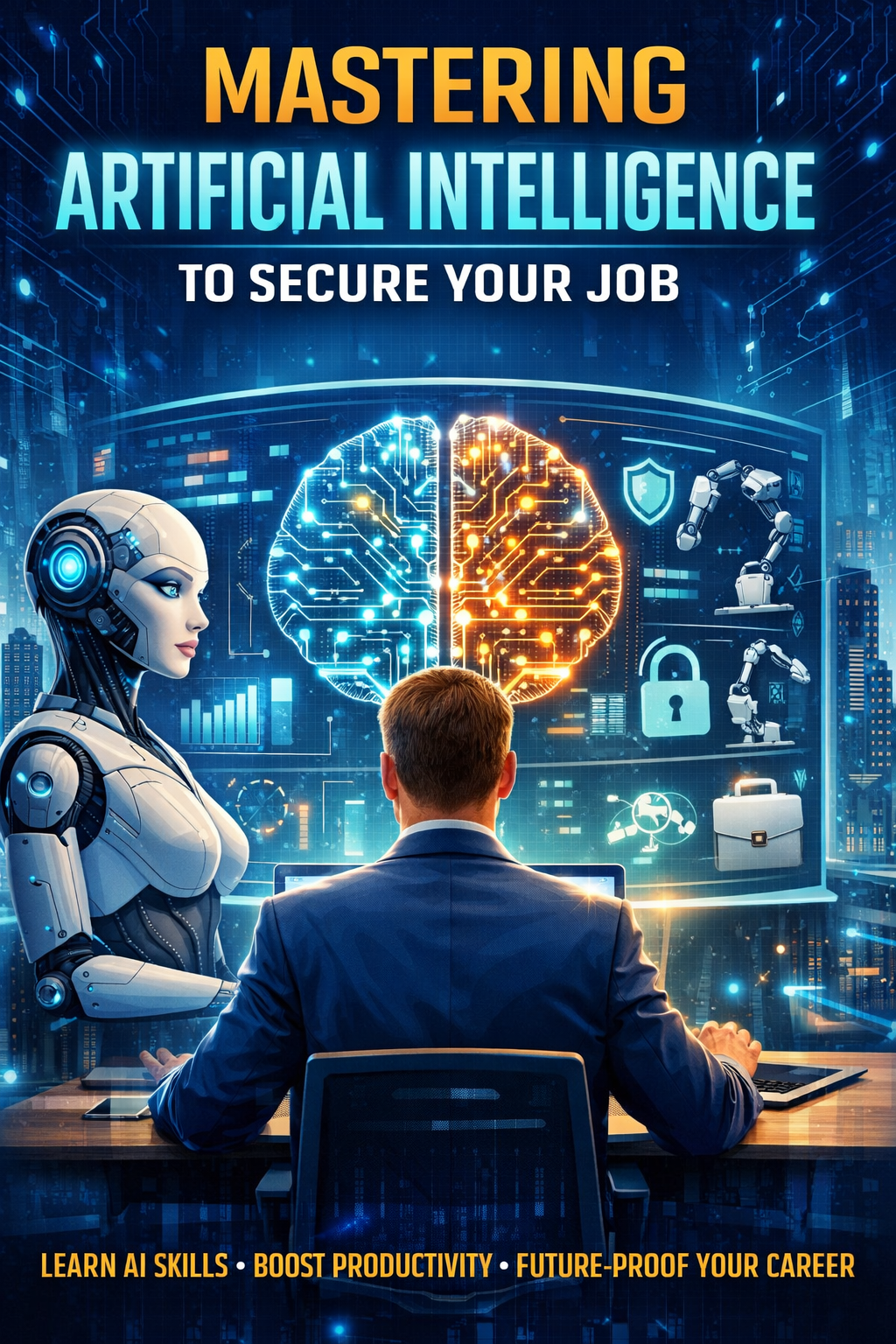
Mastering AI to Secure Your Job and Boost Your Career
Artificial intelligence is often framed as a threat in the modern workplace — something that replaces jobs and makes skills obsolete. But that framing misses the real picture. Mastering AI for professional growth is not about survival. It is about becoming the colleague who makes decisions faster, spots patterns others miss, and delivers work at a level that was impossible without machine assistance. The professionals who embrace this are not being replaced. They are being promoted.
Reframing AI as a Career Co-Pilot
Every major technological shift — from the printing press to the internet — has been met with the same fear. And every time, the people who adapted did not just survive. They flourished. AI is an evolution of human capability, not a replacement for it.
Think of artificial intelligence as the ultimate professional toolkit. By automating the mechanical parts of your day — the sorting, scheduling, summarizing — it clears space for what humans do best: critical thinking, emotional intelligence, and complex problem-solving. Those skills become exponentially more valuable when they are augmented by the speed and precision of AI.
The professionals who understand this shift are already positioning themselves differently. They stop competing on who can process spreadsheets faster and start competing on who can ask better questions, make sharper judgments, and build stronger relationships. Those are the skills that survive every technology cycle.
What AI Actually Means for Your Day-to-Day Work
At its core, AI is software that can learn, reason, and solve problems. You already use it every time your email filters spam or your phone suggests the fastest route home. It is not magic; it is applied mathematics working on your behalf.
In the workplace, this translates to tools that summarize fifty-page reports in seconds, draft responses to common inquiries, and forecast outcomes based on historical data. You do not need to be a data scientist to benefit. You just need to know what these tools can do, where to find them, and how to use them ethically in your specific role.
The barrier to entry has never been lower. Five years ago, getting value from AI required a team of engineers. Today, a single professional with a laptop and a willingness to experiment can do more with AI tools than an entire analytics department could manage a decade ago.
How AI Boosts Job Performance
Automating Repetitive Tasks
Data entry, scheduling, and basic report generation are the biggest time thieves in professional work. AI handles them seamlessly, handing back hours of your week. Use that reclaimed time to build client relationships, work on strategic projects, or develop skills that move your career forward.
The math is simple: if AI saves you ten hours a week, that is five hundred hours a year. Over a three-year period, that is nearly a full working year of time redirected toward higher-value work. That is not incremental improvement — it is career acceleration.
Enhancing Data Analysis
AI does not just read data — it finds patterns. It processes large datasets to predict outcomes and surface trends that would take a human weeks to identify. When you bring data-driven recommendations to the table, you position yourself as a forward-thinking leader in your department.
The most effective AI users combine tool output with their own domain expertise. The AI spots the signal; the human interprets what it means for the specific business context. That combination is hard to replicate and highly valued.
Improving Communication
Meeting transcriptions, action item generation, and optimal send-time suggestions all come from AI tools you can set up in minutes. Your communication becomes sharper and more timely — like having a professional assistant dedicated to keeping you synchronized and effective.
This is especially valuable for distributed teams. When half your colleagues work in different time zones, AI-generated meeting summaries and async updates keep everyone aligned without requiring everyone to attend every meeting.
Personalizing Customer Experiences
AI helps you understand customers at a granular level. By analyzing preferences and predicting needs, you provide tailored experiences that build loyalty. Routine questions go to chatbots so you can focus on the complex cases that actually need your judgment.
The professionals who combine AI-driven insights with genuine human empathy are in short supply. Automation handles the volume; you handle the relationship. That combination is where careers grow.
Boosting Creativity
Staring at a blank page? AI can generate headline options, draft content frameworks, or offer design variations. It handles the initial grunt work of ideation so you can focus on refining and perfecting the final product.
Creativity professionals often worry that AI will make their work generic. The opposite is true for people who use it well. By offloading the mechanical parts of creative work — the first draft, the layout, the research — AI leaves more mental energy for the distinctive, original thinking that actually breaks through.
For a broader look at how these capabilities translate into measurable gains across your organization, see our guide to Workplace Productivity Through AI Training .
Practical Steps to Start Building AI Skills
Start Small
Do not try to change everything at once. Pick one repetitive task — sorting through email, summarizing research, drafting routine updates — and find an AI tool that helps. Small wins build the confidence needed for larger changes.
Track your first win. Note how much time it saved and whether the quality of the output was acceptable, better, or worse than your manual approach. That evidence becomes the foundation for expanding into new use cases.
Focus on Your Industry
Every field has different AI tools and applications. Marketing teams benefit from content generators and analytics platforms. Finance professionals use forecasting and anomaly detection. Healthcare workers use diagnostic support and scheduling automation. Focus on what fits your actual work.
The fastest path to competence is solving your own problems. Skip the general AI courses that teach theory. Instead, search for “AI tools for [your job title]” and start experimenting with what you find.
Practice Hands-On
The fastest way to learn is by doing. Sign up for free trials of writing assistants, data analysis tools, or image generators. Experiment with prompts. See what works and what does not. Break things and figure out why.
Set aside thirty minutes a week for deliberate experimentation. Try one new tool or one new technique. Document what you learn. After three months, you will have tested a dozen tools and built a mental model of what AI can and cannot do in your context.
Learn from Others
Join professional groups focused on AI in your industry. Follow how peers are applying tools to solve real problems. Shared experience accelerates competence faster than any course.
Why This Matters for Your Career
AI will change how work gets done, but it will not replace why work gets done. The human elements — empathy, ethical reasoning, relationship building — remain irreplaceable. When you combine those qualities with AI’s efficiency, you become what some analysts call an “AI-augmented professional”: someone capable of producing outcomes that neither human nor machine could achieve alone.
The professionals who invest in AI capability today are not securing their current job. They are evolving into the indispensable leaders of tomorrow. The journey starts with a single step — choosing to learn instead of choosing to wait.